
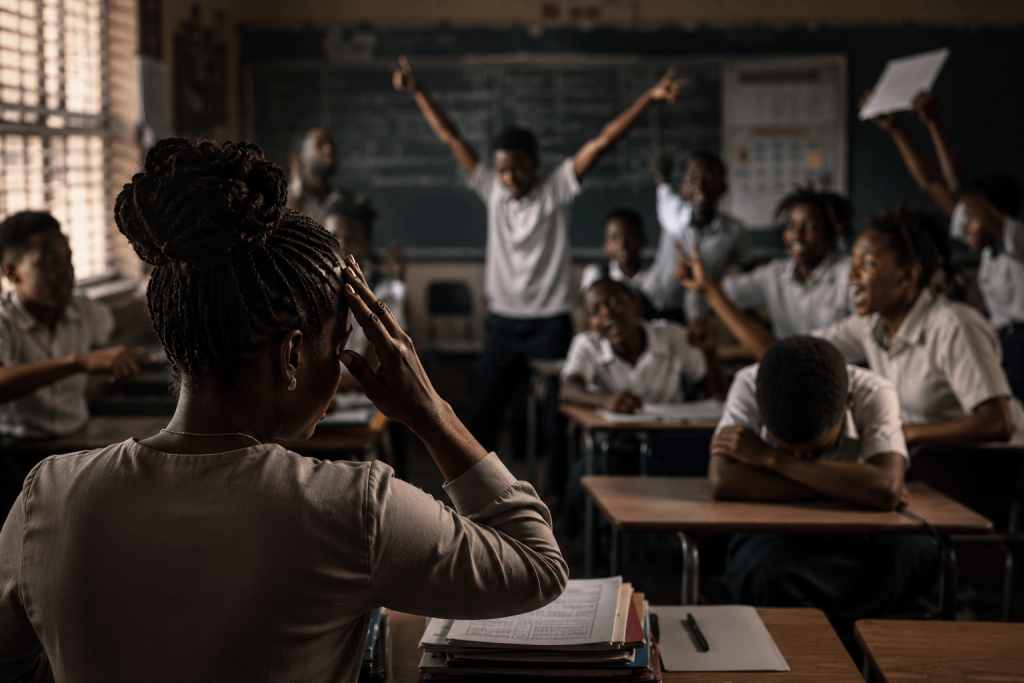
Introduction: The Classroom Ideal vs. Reality
Educators enter the profession with a desire to nurture young minds, support academic growth, and create safe, productive learning environments. Parents, too, want their children to attend schools where discipline, structure, and support enable them to thrive. Both expect that classrooms will be places of peace, not chaos.
Unfortunately, this is becoming less of a guarantee and more of a distant hope.
The Rise of Disruptive Behavior
Today, schools are increasingly confronted by a surge in deviant student behavior and what should be a space for learning and personal development is, in some cases, devolving into a daily struggle.
The reasons for disruptive behaviour can vary and may include issues such as inconsistent parenting, uncaring parents, overprotective parents, bad influences in the local community, poverty, and poor teaching environments (Berges-Puyó, 2025). The students’ lack of focus, combined with personal struggles, often leads to disruptive, sometimes dangerous, behavior.
These students bully others, interrupt lessons, steal, sell contraband, and participate in activities that jeopardize the safety of the entire school community. Often, their actions are minimized until they escalate beyond control. They intimidate classmates, silence participation, and manipulate peers into negative behaviors. Teachers face verbal abuse, threats, and in some cases, physical intimidation.
Impact on Learning and School Culture
The damage extends far beyond classroom disruption. Each incident pulls educators’ energy and attention away from the compliant students who come to school ready to learn. Administrators are forced to divert their efforts from school-wide development to the containment of repeated incidents, often spending hours dealing with combative parents who refuse to acknowledge their child’s role in the chaos.
The true cost is felt by the students who follow the rules. These students are overlooked as the system prioritizes the ones creating turmoil, and the number of such disruptive students is growing.
Discipline Measures: Inadequate and Failing
Disciplinary responses are often insufficient. For even the most serious offenses, a ten-day suspension may be the maximum consequence. After that, the student returns as if nothing happened. If no accountability is held in the home environment, then the suspension can prove to be ineffective. Others may be referred to specialized behavioral programs, but attendance is brief or inconsistent. Before long, they are back in mainstream classrooms, resuming the same harmful patterns.
What Needs to Be Acknowledged
Several difficult truths must be acknowledged:
- Many of these students are in urgent need of intervention that the traditional school system is not equipped to provide.
- Some are already engaging in criminal behavior. Their youth does not erase the danger they pose.
- Standard suspension policies are ineffective and may worsen the situation (Leung-Gagné et al., 2022), but may be necessary to protect the greater school population.
- Keeping disruptive students in mainstream environments puts others at risk, including students and staff.
A Call for Alternative Education Models
There is a moral imperative to provide alternative education models that meet these students where they are, while also protecting those who come to school to learn.
Despite efforts to promote inclusiveness and restorative practices, the reality is that traditional schools, in their current form, are not always the best environment for every child. Without systemic reform, more classrooms will descend into conflict, and more students will be left behind due to fear, lost instruction, or discouragement. Fitzgerald (2016) indicated that teachers, parents, and researchers have recognized that unruly students in classrooms can impact the quality of education for other pupils, which has been difficult to estimate.
The Cost of Inaction
In many schools, this is not a prediction. It is already a reality.
Principals and school leaders are under growing pressure to reduce suspensions. However, the safety and learning of the wider student body must not be compromised in the process. Policymakers must acknowledge the limitations of current systems and fund viable, well-resourced alternatives which benefit disruptive students who are crying out for help. Parents must also be held accountable for the behavior they enable or ignore.
The future of societies depends on how this growing problem is effectively managed. We must avoid putting pressure on already strained systems that are not equipped to handle these issues in their current form. It is time to take the requisite steps in the right direction to promote the success of the next generation.
What Authors Are Saying
Berges-Puyó (2025): Disruptive behaviour can result in students’ frustration, disengagement, lack of motivation, teacher burnout, lower academic achievement, loss of instructional time, and worsening of school and classroom culture and morale.
Fitzgerald (2016): In The Long-Run Effects of Disruptive Peers (NBER Working Paper 22042), Scott E. Carrell, Mark Hoekstra, and Elira Kuka report that classroom disruptions lead to more than just short-term lower grades and test scores. They also harm the long-term college, career, and income prospects of other pupils.